2026 MLC Chair’s Initiative: Literacy in Action
 Minnesota Sen. Mary Kunesh has made “Literacy in Action” the subject of her 2026 Midwestern Legislative Conference Chair’s Initiative. In support of this initiative, CSG Midwest is developing a series of policy resources and programming for legislators throughout the year.
Literacy is the building block for students to succeed academically, as well as for people of all ages to prosper in their economic and civic lives. States play a critical role in helping build this foundation for young people — through the investments they make, the standards they set, and the laws they enact.
 The yearlong focus on literacy aims to provide legislators with policy ideas to improve literacy instruction and student achievement in state education systems.
New laws, investments and strategies in the 11-state Midwest are highlighted in “Literacy in Action: How Midwest States Are Providing New Tools For Students and Teachers to Succeed.”
This comprehensive report, written by CSG Midwest policy analyst Derek Cantù, also examines the impacts of state actions to date; provides state-by-state data on trends in fourth-grade reading scores; and shows gaps in performance in every Midwestern state by race, ethnicity, gender and family income.
Literacy policy was the subject of featured sessions at the 2026 Midwestern Legislative Conference (MLC) Annual Meeting, which was held Aug. 30-Sept. 2 in Minnesota’s capital city of Saint Paul. Sen. Kunesh led a session that included a presentation from and a Q & A with Carey Wright, the current state superintendent of schools for Maryland who previously served as state superintendent of education in Mississippi. Dr. Wright discussed her role in elevating Mississippi to become a national leader in literacy instruction and outcomes during her nine-year term.
 At the meeting, too, members of the MLC adopted a policy resolution on federal investments in literacy policy. The resolution urges continued investments by the U.S. Congress in the Comprehensive Literacy State Development Grant Program, along with a modernization of the program so that it reflects recent state reforms: alignment with the science of reading, the use of evidence-based interventions for struggling or at-risk students, and certain conditions of licensure or certification for kindergarten through eighth-grade teachers.
MLC Resolution on Future of Federal Literacy Investments
Data Snapshot on Literacy
State-by-state results on National Assessment of Educational Progress (NAEP)
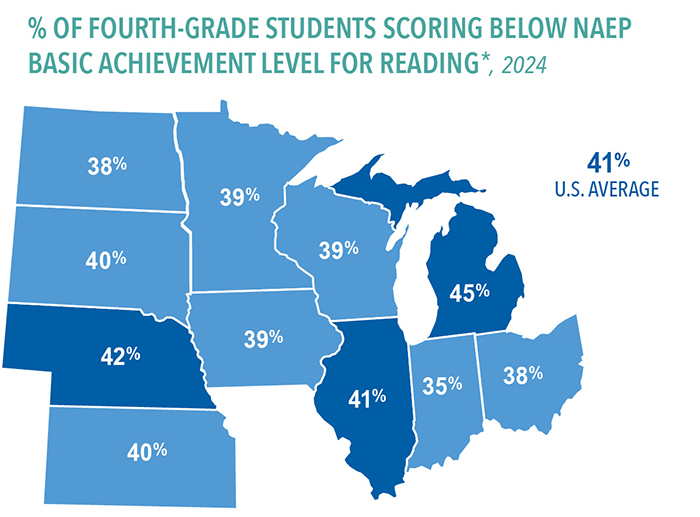
*The NAEP basic level denotes partial mastery of prerequisite knowledge and skills that are fundamental for performance at the NAEP proficient level.
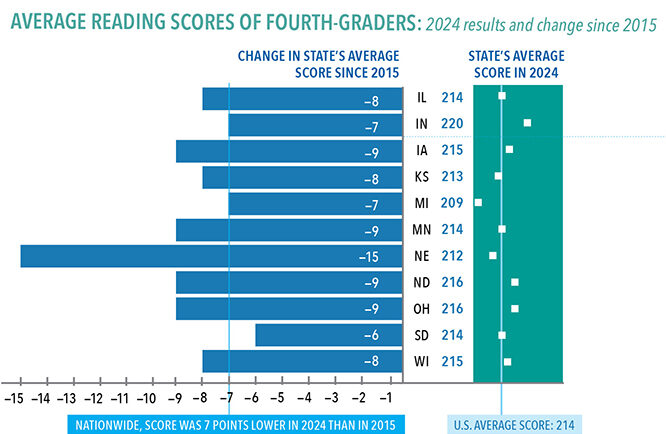
A basic reading score is between 208 and 237.
Results of the most recent NAEP tests are from 2015, 2017, 2019, 2022 and 2024. Since at least 2019, average reading scores for fourth-graders have fallen in every Midwestern state, with one exception: Indiana’s increase in the average score from 2022 to 2024 (217 to 220).
Source: The National Assessment of Educational Progress, “The Nation’s Report Card”
Before and beyond school age: literacy skills among young children and adults
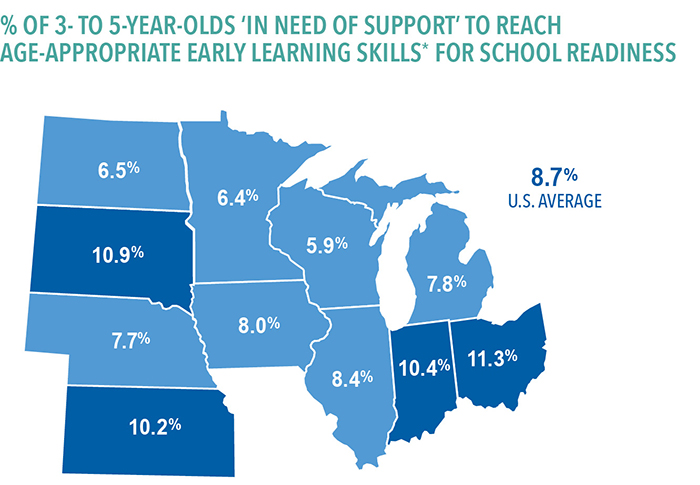
* Early learning skills are based on nine variables related to numeracy and language arts. “Needs support” indicates the child is below age-appropriate developmental expectations.
Source: 2023-2024 National Survey of Children’s Health, The Child & Adolescent Health Measurement Initiative
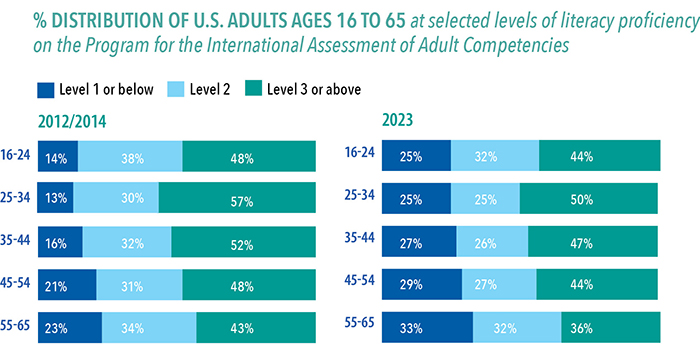
Level 1 or below: Adults at below Level 1 are able to process meaning at the sentence level. Adults at Level 1 are able to locate information on a text page, find a relevant link from a website, and identify relevant text among multiple options when the relevant information is explicitly cued.
Level 2: Adults are able to access and understand information in longer texts with some distracting information.
Level 3 or above: Adults at Level 3 are able to construct meaning across larger chunks of text or perform multi-step operations in order to identify and formulate responses.
Source: National Center for Education Statistics