Four Midwest states have new, distinct laws on participation by employers in federal E-Verify
Since it began nearly 30 years ago, the federal E-Verify system has spurred action in the states, including laws on contracting and/or business licensing that require employers to check whether newly hired employees are authorized to work in the United States. According to the Migration Policy Institute, as of 2025, 10 U.S. states (concentrated mostly in the South) mandated that all or most employers use E-Verify. Another 11 states were requiring its use by public employers and/or government contractors.
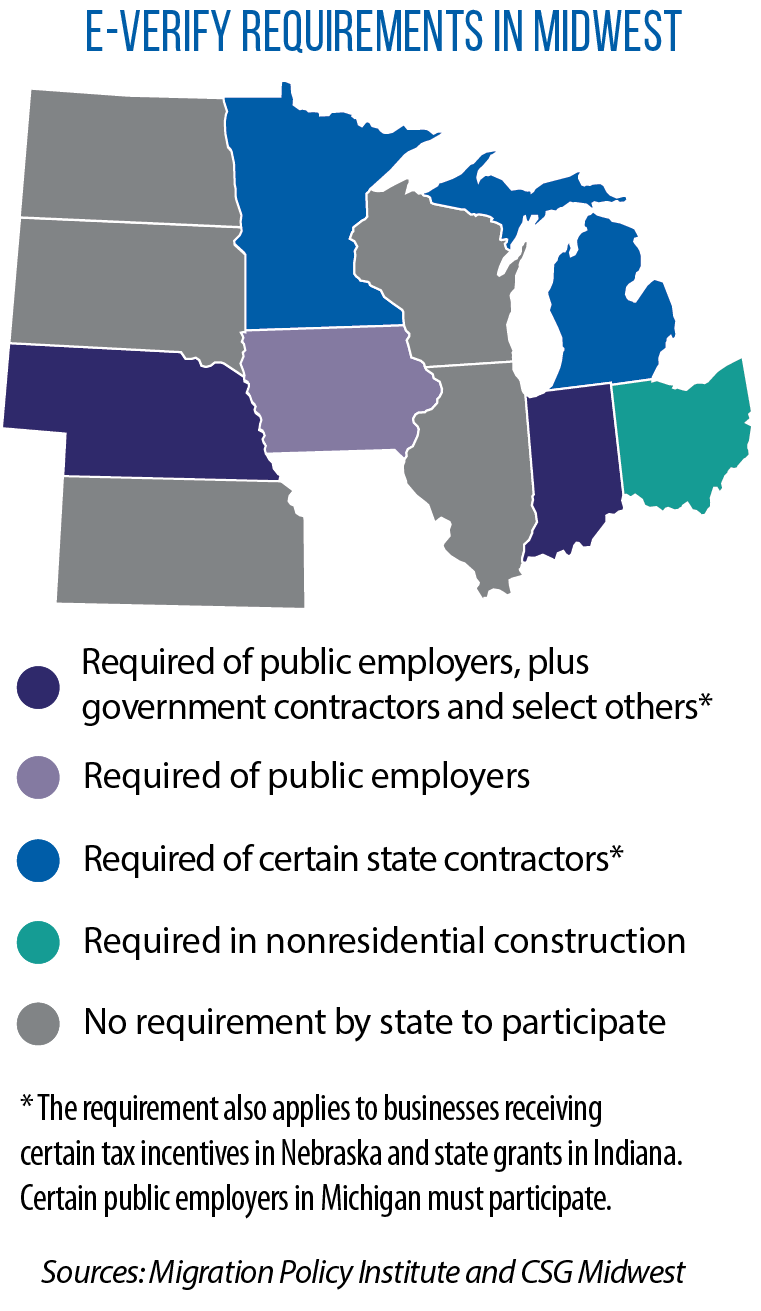 Legislative developments in Iowa, Indiana, Ohio and Illinois are changing those four Midwestern states’ approaches to E-Verify, the federal government’s web-based system through which employers electronically confirm the employment eligibility of workers. Here is a summary of the new laws in place in these states.
- In Iowa, state agencies and local school districts are among the public employers now statutorily required to use the E-Verify system. SF 2218 (signed into law in June 2026) also establishes criminal penalties for individuals who provide a false Social Security number to an employer. Businesses that knowingly accept false Social Security numbers or knowingly hire individuals that provided false numbers can be subject to enforcement action and civil fines.
- Indiana’s approach under this year’s SB 76 is twofold. First, add statutory language that prohibits all employers from knowingly or intentionally recruiting, hiring or employing unauthorized individuals and that establishes graduated penalties for noncompliant businesses. Second, shield employers from liability if they used E-Verify during the hiring process.
- Ohio’s new law (HB 246 of 2025) took effect in March 2026. It requires E-Verify within a particular industry sector, specifically all contractors, subcontractors and labor brokers involved in nonresidential construction. Fines for noncompliance will go to an E-Verify Enforcement Fund.
- Two recent Illinois laws (SB 508 of 2024 and SB 2339 of 2025) seek to provide protections for individuals who have the legal right to work in the United States but face E-Verify problems due to discrepancies in the paperwork. These workers must be given a chance to fix the discrepancies as well as be afforded certain legal protections. The Migration Policy Institute notes, too, that Illinois employers using E-Verify must meet requirements on program training and proper reporting to employees.
Nationwide, close to 1.4 million employers participated in E-Verify in 2025.