With less gas being pumped, states pursue new options to fund roads
Since the start of this decade, the number of vehicle miles traveled in the United States has increased, eclipsing 9 billion miles per day in 2025.
Falling over this same time, though, has been the consumption of gasoline — a drop of 4 percent from the pre-pandemic demand level of 2019.
“Each vehicle, or each driver, is providing less typically right now,” says Adie Tomer, a senior fellow at the Brookings Institution, noting the loss of “purchasing power” from state and federal gas taxes.
Recent federal studies underscore this point.
The U.S. Energy Information Administration analysis detailing recent declines in motor fuel consumption says this trend will continue because of future increases in fuel efficiency.
This decade, separate EIA data show, sales of electric, hybrid electric and plug-in hybrid vehicles have increased 364 percent. They now account for close to 25 percent of all U.S. sales of new light-duty vehicles.
 Less gas being pumped means more questions about how to fund roads and highways, a responsibility that primarily rests with state and local governments. (Non-federal spending accounts for 77 percent of the total, according to the U.S. Congressional Budget Office.)
“If you ever try to raise money for anything, it always helps to get different pots of money. … It’s good to have that resiliency and the stability,” says Philip Plotch, a principal researcher and senior fellow for the Eno Center for Transportation. 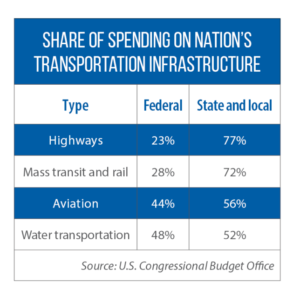
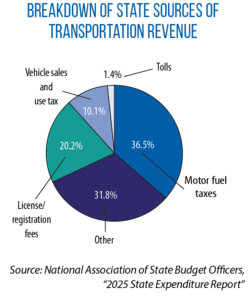
States appear to be diversifying their financing models for transportation. In 2025, the share of U.S. states’ transportation revenue coming from the gas tax was 36.5 percent. It was 41.1 percent in 2016, according to the National Association of State Budget Officers.
Over this time, the NASBO study notes, states have been imposing other user-based fees to help meet their infrastructure needs. That includes increased registration fees, including surcharges on electric and hybrid vehicles, as well as fees at charging stations. States also are studying, piloting and even implementing (in Hawaii) programs that charge vehicle owners based on miles traveled.
Other options beyond the gas tax under consideration: tolls, public-private partnerships, sales taxes, and revenue from expansions in legalized gambling or marijuana. Here is a look at some of the notable recent developments in the Midwest.
‘More flexibility’ — and revenue sources
Signed into law in April 2026, Nebraska’s LB 1126 establishes a framework for new state-local partnerships on transportation, plus the involvement of the private sector in local road projects.
The newly created Infrastructure Development Investment Program will essentially function as a state infrastructure bank. Loans, grants, bonds and other financing from various sources will be made available for local transportation projects.
“It’s important to give more flexibility to local governments, counties and cities, and how they finance [projects],” says Sen. Mike Moser, primary sponsor of the bill.

Sen. Mike Moser
“And then we’re hoping that the Legislature has money to fund it at some future time, or that we get some federal dollars that we could use in this program. But a lot of federal dollars come with strings, and so it would have to be the right kind of grant money.”
Nebraska’s political subdivisions are now authorized to enter into public-private partnerships, or P3s, for the construction or financing of capital projects. P3s are long-term contractual agreements between a public agency and a private entity to design, finance, build and maintain infrastructure.
“P3s can accelerate project delivery, not only through efficiencies provided by the private sector to accelerate construction, but also by shaping the start of the project implementation so that the public can benefit from the early completion of the project, also saving money,” says Qingbin Cui, director of the Build America Center at the University of Maryland.
Moser lists many of those same potential benefits in explaining why Nebraska has embraced the P3 concept.
Nebraska also has been dedicating general sales-tax revenue to road projects. The amount is one quarter of 1 percent, as required under a law enacted in 2011 and extended in 2023 (LB 727).
In Illinois, as part of a major new capital plan enacted in 2019, legislators approved a gradual shift in the use of revenue from the state sales tax on motor fuels: away from the state general fund and toward the Road Fund. (Subsequent legislative actions have used this revenue source for other uses, including public transit.)
Rebuild Illinois also raised the per-gallon tax on gas and other fuels as well as increased registration fees.
Michigan: Marijuana tax
Road funding has been a much-discussed topic for years in Michigan. A bipartisan deal reached in 2025 sets a new framework for funding the state’s transportation infrastructure.
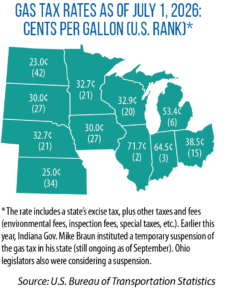
First, the Legislature made gas purchases exempt from the 6 percent sales tax (HB 4183), replacing it with a 20-cent increase in the per-gallon gas tax. A key difference in these two revenue sources: the gas tax must go to transportation funding under the Michigan Constitution; no such restriction exists for the sales tax.
Legislators also are tapping into a newer revenue stream — namely, a 24 percent tax on the wholesale price of marijuana (HB 4951). The new tax took effect at the start of 2026 and was expected to bring in about $420 million a year. These dollars will go mostly to the Neighborhood Road Fund (also created in 2025), which supports local and regional transportation projects.
In all, the bipartisan package of bills from 2025 is estimated to bring in $1.85 billion a year for Michigan roads.
Higher electric vehicle fees
One of the changes in Michigan (HB 4183) has increased the state’s annual registration surcharge on electric vehicles, up to $267 in 2026 (third-highest in the nation, according to the Tax Foundation). Michigan’s fee for plug-in hybrid vehicles is $113.
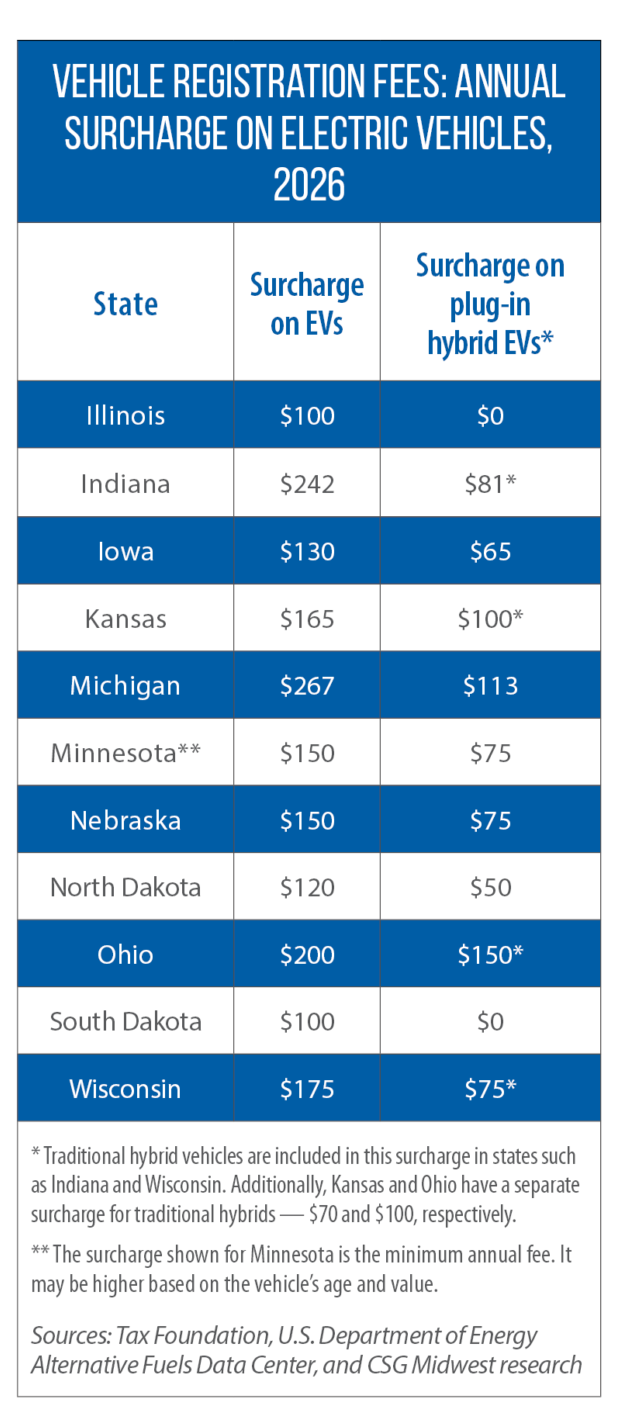
As part of the Rebuild Illinois law from 2019, legislators added a $100 yearly surcharge on electric vehicles.
In Minnesota (HF 14 of 2025, special session), the annual EV surcharge has been increased from the previous flat fee of $75. At a minimum, the new surcharge is $150 for electric vehicles and $75 for plug-in hybrid electric vehicles. But a sliding-scale calculation (based on the vehicle’s age and value) will make the fee higher for some owners.
The same Minnesota law also establishes a new tax on the operators of public charging stations: 5 cents per kilowatt-hour of electricity. The tax, which takes effect in July 2027, does not apply if the station offers free charging or if it has a charging capacity of less than 50 kilowatts.
Indiana: Potential new tolls
Under HB 1461 of 2025, Indiana’s governor was granted authority to seek a federal waiver for the tolling of lanes on existing interstate highways. If such a waiver is granted, the legislature would not need to enact enabling legislation for tolling to begin.
A legislative fiscal analysis for HB 1461 notes that a previous study found that Indiana could receive approximately $38 billion in revenue from tolling between 2029 and 2050.
The Indiana Department of Transportation now has applied for a waiver with the Federal Highway Administration. According to the Indiana Capital Chronicle, the plan eyes tolling on Interstate 70: a 10-cent-per-mile toll for passenger vehicles and a 54-cent-per-mile toll for semi-trailers on I-70. It outlines roughly $6.5 billion in improvements to that highway.