How a big, new federal law will impact SNAP and the states that administer the anti-hunger program
Among the many provisions in HR 1 — the One Big Beautiful Bill Act, signed into law in July 2025 — are changes to two major safety-net programs: the Supplemental Nutrition Assistance Program (SNAP), an anti-hunger program that provides food benefits to low-income households, and Medicaid, which provides public health insurance to eligible individuals and families. States are partners with the federal government in both of these programs.
In support of its work on behalf of The Council of State Governments’ Midwestern Legislative Conference Health & Human Services Committee, CSG Midwest is analyzing the impacts of HR 1 on the 11 states in the Midwest, with a particular focus on direct fiscal impacts.
The first analysis, produced in July 2025, examines changes in SNAP. A second analysis, produced in December 2025, focused on Medicaid, including administrative challenges for states in implementing HR 1’s new work requirements as well as new fiscal restraints and responsibilities being placed on states.
Here are three takeaways for state policy leaders in the Midwest regarding the future of SNAP under this far-reaching federal law.
#1: Potential loss of federal dollars will depend on your state's SNAP error rate
For the first time, starting in 2028, some states may be required to contribute to some of the costs of providing SNAP benefits, depending on their payment error rate in the program in fiscal years 2025 or 2026.
Improper payments in SNAP occur due to errors by state agencies (a problem with application processing and data matching) or recipients (failure to provide timely or accurate information).
Learn about causes of error rates and actions to reduce them
Under HR 1:
- The federal government will continue to cover 100 percent of the costs of SNAP benefits in states with a payment error rate of less than 6 percent.
- The federal government will cover 95 percent of the costs of SNAP benefits for states with a payment error rate “equal to or greater than 6 percent but less than 8 percent.” States in this category will be responsible for 5 percent of the costs of SNAP benefits.
- The federal government will cover 90 percent of the costs of SNAP benefits for states with a payment error rate “equal to or greater than 8 percent but less than 10 percent.” States in this category will be responsible for 10 percent of the costs of SNAP benefits.
- The federal government will cover 85 percent of the costs of SNAP benefits for states with a payment error rate of 10 percent or greater. States in this category will be responsible for 15 percent of the costs of SNAP benefits.
- There is an exception made for certain states with especially high payment error rates. Implementation of the new cost share is delayed “if the payment error rate of a state multiplied by 1.5 is equal to or above 20 percent.” For FY 2024, a handful of U.S. states, but none in the Midwest, fall into this category of states that meet the exception.

Change in federal cost share for SNAP benefits if state's FY 2024 error rate holds in FY 2025 and 2026 |
|
|---|---|
| State | Change |
| Illinois | Reduction from 100% to 85% |
| Indiana | Reduction from 100% to 90% |
| Iowa | Reduction from 100% to 95% |
| Kansas | Reduction from 100% to 90% |
| Michigan | Reduction from 100% to 90% |
| Minnesota | Reduction from 100% to 90% |
| Nebraska | No reduction; stays at 100% |
| North Dakota | Reduction from 100% to 95% |
| Ohio | Reduction from 100% to 90% |
| South Dakota | No reduction; stays at 100% |
| Wisconsin | No reduction; stays at 100% |
Benefit payments through SNAP in FY 2024 |
|
|---|---|
| State | Amount |
| Illinois | $4.5 billion |
| Indiana | $1.4 billion |
| Iowa | $528.9 million |
| Kansas | $408.4 million |
| Michigan | $3.1 billion |
| Minnesota | $856.3 million |
| Nebraska | $331.7 million |
| North Dakota | $111.4 million |
| Ohio | $3.2 billion |
| South Dakota | $180.2 million |
| Wisconsin | $1.4 billion |
How much states would have lost in federal dollars in FY 2024 under HR 1 (based on amount of SNAP benefit payments and SNAP error rate that year) |
|
|---|---|
| State | Loss in federal dollars |
| Illinois | Loss of $670.4 million |
| Indiana | Loss of $143.6 million |
| Iowa | Loss of $26.4 million |
| Kansas | Loss of $40.8 million |
| Michigan | Loss of $306.1 million |
| Minnesota | Loss of $85.6 million |
| Nebraska | No loss (error rate below 6 percent) |
| North Dakota | Loss of $5.6 million |
| Ohio | Loss of $317.8 million |
| South Dakota | No loss (error rate below 6 percent) |
| Wisconsin | No loss (error rate below 6 percent) |
Note: Figures for the tables come from the U.S. Department of Agriculture, Food and Nutrition Service; calculations were done by CSG Midwest
#2: All states will see reductions in federal support for SNAP administrative costs
Starting in FY 2027, the federal government’s reimbursement rate to states for SNAP-related administrative costs will drop, from the current rate of 50 percent down to 25 percent. This map shows state-by-state total administrative costs in FY 2023. States will take on a higher share of these SNAP administrative costs starting in FY 2027.
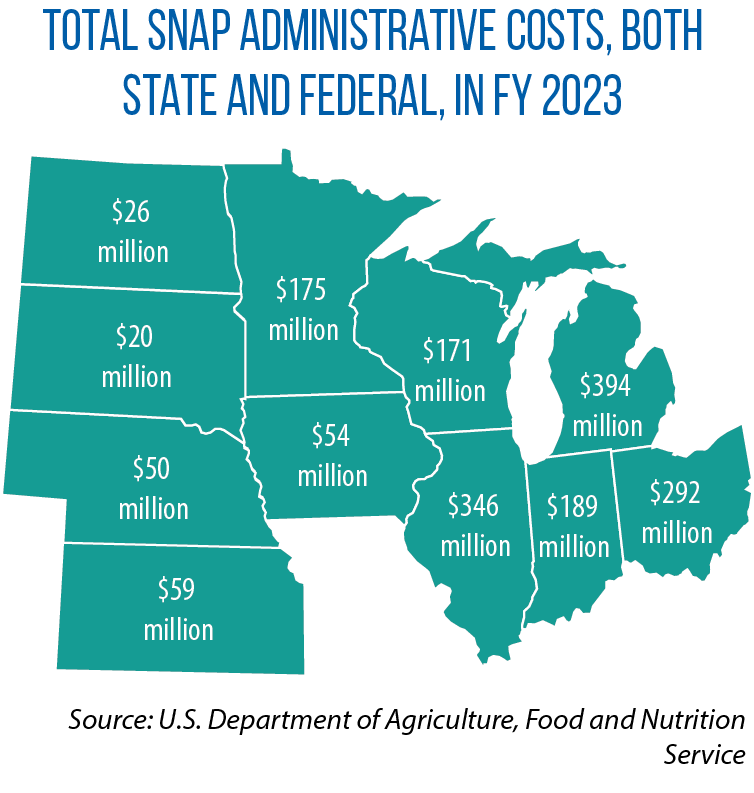
Under SNAP, states report their administrative expenses (salaries, benefits, training, technical assistance, etc.) via financial reporting to the federal government and seek reimbursement for “allowable costs.”
In a 2019 study for the U.S. Department of Agriculture’s Food and Nutrition Service, researchers explored the causes of state-by-state variations in the administration of SNAP. States that had streamlined and modernized program policies, including simplified reporting, had some success in reducing per-caseload costs, the researchers found. Other factors include the wages of social service workers as well as caseloads per worker.
#3: SNAP work requirements will expand to new populations in every state
Already under SNAP, two types of work requirements are in place:
- The General Work Requirements
- The more-stringent Able-Bodied Adults Without Dependents (ABAWD) Work Requirement and Time Limit. The time limit is three months within a three-year period. Receiving benefits beyond this limit is dependent on meeting SNAP work requirements.
HR 1 makes changes in both of these work requirements.
Change in the General Work Requirements
Under current program rules, to get SNAP benefits, individuals between the ages of 16 and 59 must meet “general work requirements.” The new federal law changes this range; it is now ages 17 to 64.
Expansion of the ABAWD work requirement and time limit
The new federal law expands the number of people subject to the stricter Able-Bodied Adults Without Dependents Work Requirement and Time Limit. Notably, the age at which Able-Bodied Adults Without Dependents are subject to work requirements and the time limit has been raised from 54 to 64. Another significant change impacts able-bodied adults with dependents of a certain age. For SNAP purposes, the definition of dependent child now is under age 14. As a result, the time limit and work requirements will apply to the able-bodied parents of school-aged children over the age of 14.
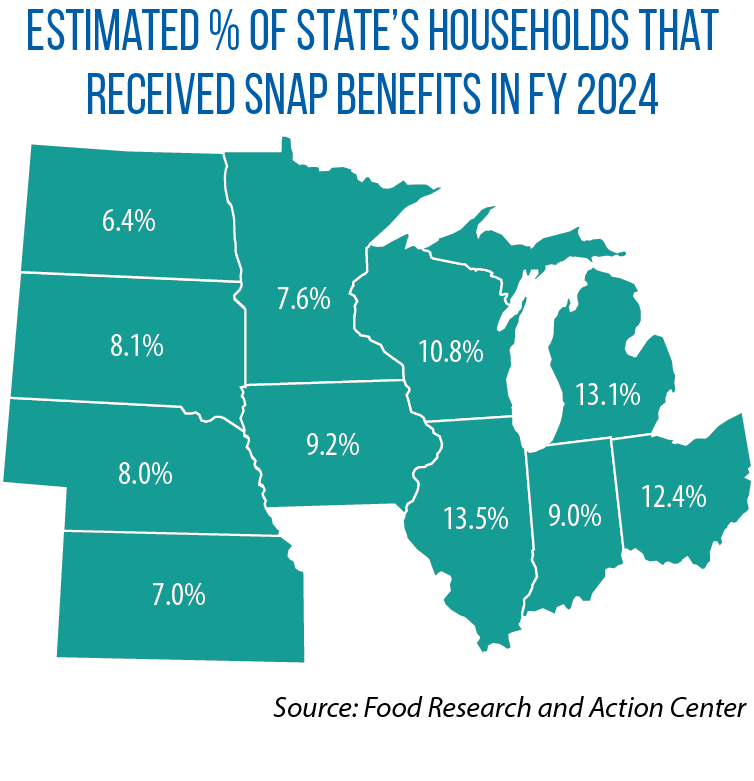
According to a 2021 USDA study, Able-Bodied Adults Without Dependents represent a relatively low share of SNAP participants — anywhere from 4 percent to 9 percent.