Illinois is first Midwest state to legalize medical aid-in-dying option for terminally ill patients
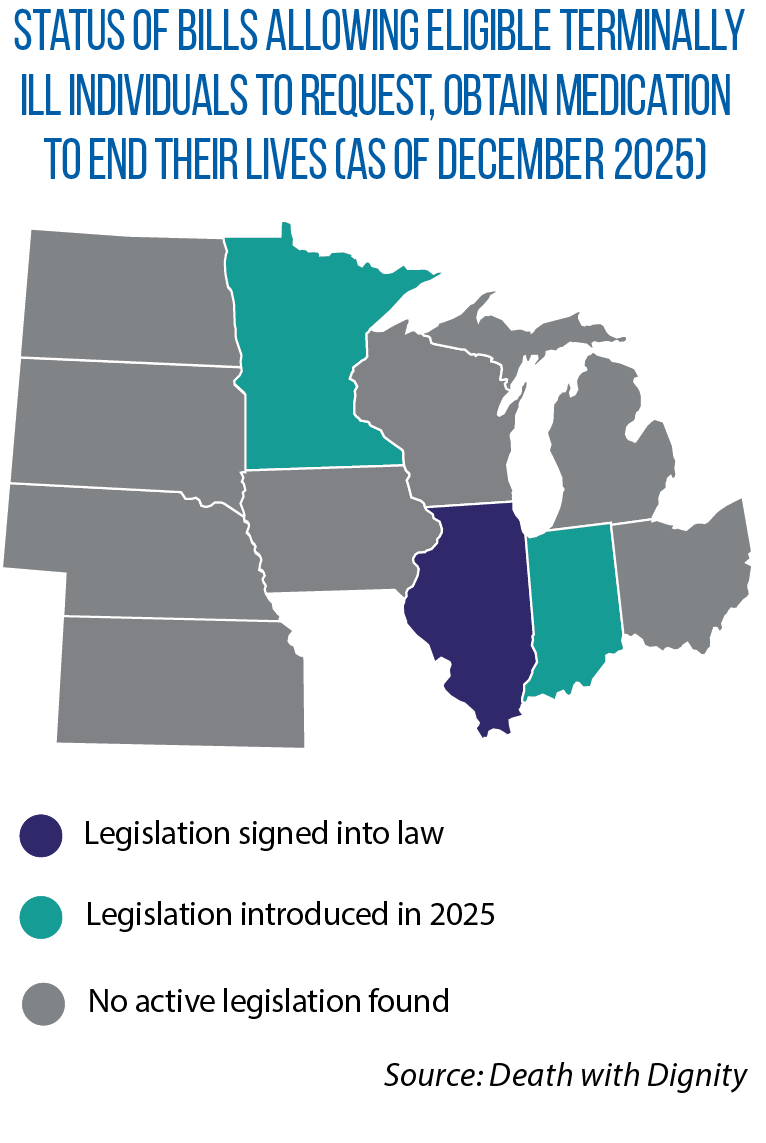
Starting in the latter part of 2026, Illinois will begin allowing terminally ill, mentally capable adults to obtain and self-administer medication to end their lives. Legislators passed SB 1950 during the fall 2025 veto session of the Illinois General Assembly; Gov. JB Pritzker signed the measure in December.
According to the advocacy group Death with Dignity, similar bills were passed in 2025 by legislatures in Delaware (signed into law) and New York (awaiting a decision by the governor as of early December). Illinois became the 12th U.S. state, and first in the Midwest, with such a law.
 Under SB 1950, individuals with a prognosis of six months or less to live can request a prescription for aid-in-dying medication. The oral and written requests can only be made by the patient to the patient’s attending physician. SB 1950 includes language for what that written request should entail. (A written, signed request is required.)
The attending physician’s duties include determining the mental capacity of the patient (with referral to a mental health profession if warranted), confirming that coercion did not play a role in the request, providing information on other end-of-life treatment options, and referring the patient to a consulting physician for medical confirmation. No health care provider is required to participate, and SB 1950 makes it a felony to coerce anyone to request the medication or to forge a request.
The Illinois Department of Public Health will produce annual reports on the number of prescriptions for aid-in-dying medication, the number of physicians who prescribed it, and the number of deaths. Oregon’s Death With Dignity Act was the first of its kind in the nation and dates back to 1997. In 2024, there were 607 recipients of aid-in-dying medication in Oregon and 376 deaths. The number of deaths under the Oregon law has risen over time — from 42 in 2003, to 73 in 2014, to a high of 386 in 2023 (followed by the slight decline in 2024).
Over the past five years, these measures have been introduced but not passed in several Midwestern states: Indiana (HB 1011 of 2025), Iowa (SF 2101 and HF 2288 of 2024), Kansas (HB 2202 of 2021), Michigan (SB 681 of 2023), Minnesota (SF 3215 of 2025), and Wisconsin (AB 781 of 2024).
Canada has allowed eligible adults to request medical assistance in dying for nearly a decade. The federal law does not make eligibility contingent on a terminal illness; the criteria is having a “grievous and irremediable medical condition.” The aid-in-dying medication can be administered by either a health professional or the patient. In 2023, the number of medically assisted deaths in Canada reached a one-year high of 15,343 — 4.7 percent of all the country’s deaths that year.