From tax credits to pension support to award programs, states seek more volunteer firefighters
Communities of the Midwest have long relied on volunteer firefighters and other emergency first responders. Another commonality stretching across state lines: concerns about the loss of these volunteers as retention and recruitment challenges mount.
Demands on time. Increased training requirements. Aging populations. Those are among the biggest obstacles to securing an adequate number of volunteer firefighters and emergency responders, according to the U.S. Fire Administration. “The root causes … have remained similar over the past decade,” it notes in a 2023 study. “What has changed is the pace of the contributing factors and the urgency needed to address them.”
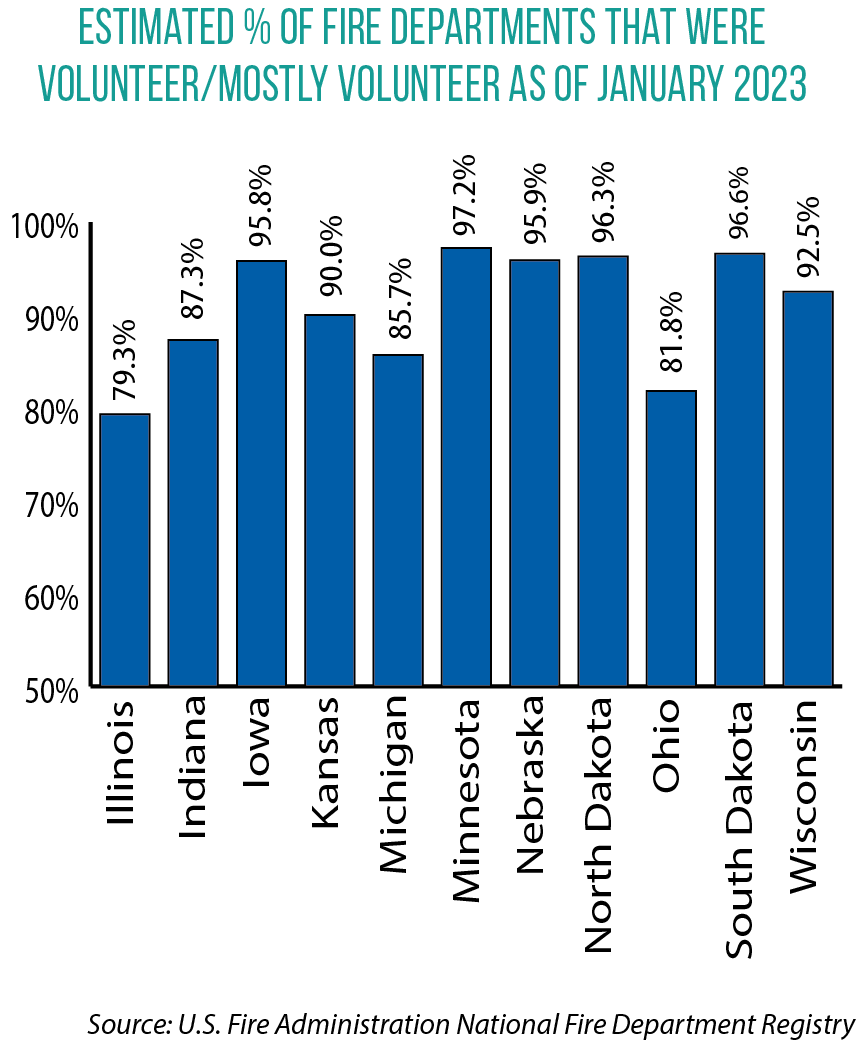 The region’s state legislators are taking notice.
In 2025, bills were passed in North Dakota calling for an interim study and legislative recommendations to boost recruitment (HB 1311) and in Iowa to establish a Length of Service Award program (HF 1002). Iowa’s program will offer a new tax-deferred benefit (for example, contributions to a retirement savings account or cash payment) for volunteer firefighters, emergency medical technicians and reserve police officers. The decision on whether to establish a Length of Service Award — and the program’s rules and benefits — is left to municipalities. However, HF 1002 creates a $1.5 million state matching program to help local governments fund these programs. State dollars will come from Iowa’s tax on sports wagering.
Wisconsin has had a Length of Service Award program for more than 20 years. A proposed expansion of this program (AB 187/SB 186 of 2025) would create a “completion service award”: $500 for a volunteer firefighter who completes 60 hours of training. Half of these dollars would come from the state; the other half from the municipality.
Some states also provide support for pension or other retirement programs. Minnesota, for instance, allocates $5.5 million every year for the retirement plans of fire relief associations and for firefighters covered by the Statewide Volunteer Firefighter Retirement Plan (the latter is administered by the state’s Public Employees Retirement Association). Kansas uses a 2 percent tax on fire and lightning insurance premiums to assist local firefighter relief associations; one potential use of these funds is an annuity for volunteer firefighters.
Another policy option is tax credits. Recent legislative activity in the Midwest has included Iowa’s increase of an existing income tax credit from $100 to $250 and a two-bill legislative package in Michigan (HB 4431 and HB 4432 of 2025) that would establish a $2,500 refundable state income tax credit for volunteer firefighters and emergency services personnel.
In Illinois, a Volunteer Emergency Worker Tax Credit has been in effect since 2023; it is a non-refundable income tax credit worth up to $500. A legislative proposal this year (HB 1386) called for increasing the credit to $1,000. A 2023 law from Illinois (SB 1611) grants state employees a paid leave of absence for participation in firefighter training.