Carrying the load: How states are planning for growth in data centers
Data centers are becoming a conundrum for state policymakers.
As repositories for terabytes of digital images, information and artificial intelligence applications, they are both home to “the cloud” and key to the digital economy. They also can provide jobs and property tax revenue in communities needing both.
But their proliferation and need for plentiful power and water have sparked concern from voters to city halls to state capitols and beyond.
In the Midwest, only a few years ago, much of the talk in the region’s legislatures centered on tax incentives to attract data centers. More recently, attention has turned to potentially scaling back those incentives, ramping up regulation and oversight, or even halting projects altogether.
Meanwhile, communities across the region are becoming the homes of new data centers. Many more projects are coming soon.
Among Great Lakes states, the number of data centers is expected to increase by 41.9 percent over the next few years, a figure based on projects being planned or already under construction, according to a January 2026 study prepared for the Joyce Foundation.
Illinois and Ohio have the region’s largest number of planned projects; by 2030, data centers’ share of total electricity demand in those two states are expected to reach 16 percent and 11 percent, respectively, the study says.
A separate analysis from the Electric Power Research Institute estimates the share to exceed 20 percent in Indiana, Iowa and Nebraska.
Brad Teitz, director of state policy for the Data Center Coalition, says the industry is open to reasonable state regulation as digital infrastructures continue to get built out.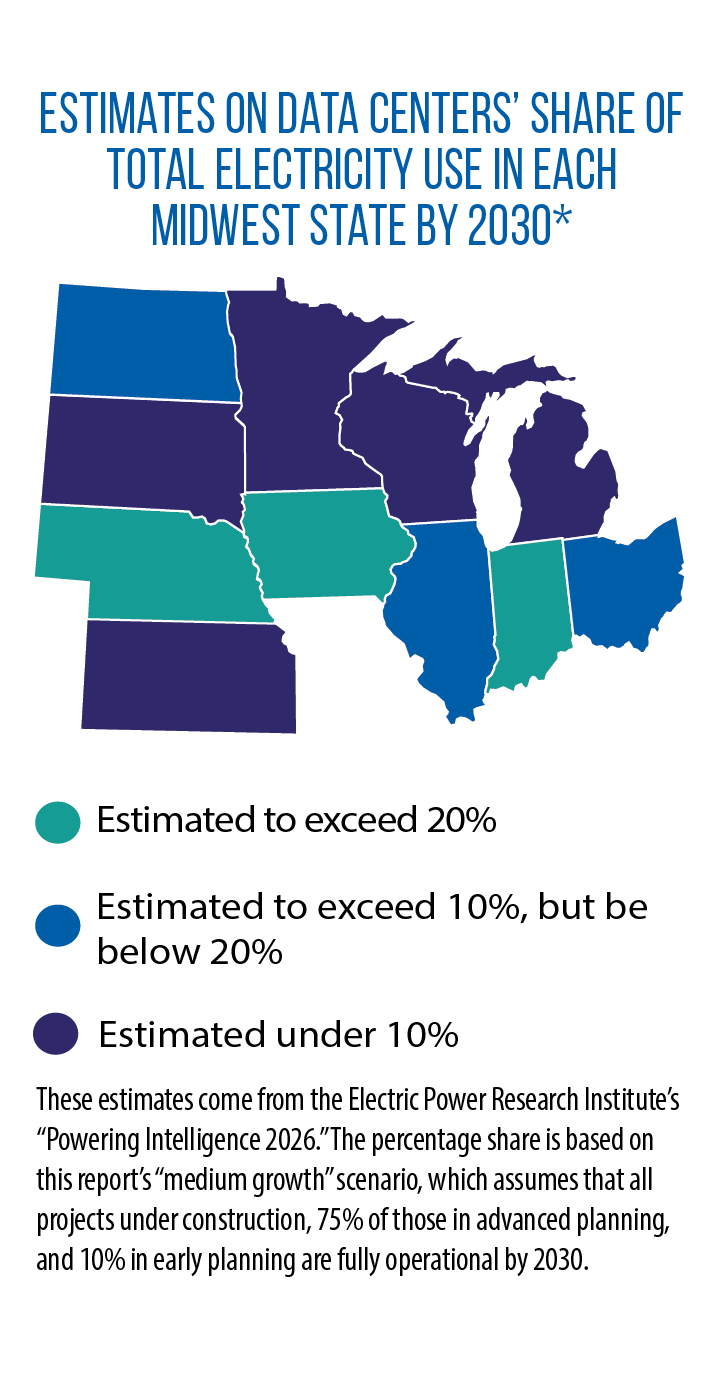
“Quite frankly, a balanced kind of approach to this could lead to greater certainty and stability for the industry,” he notes.
For example, Tietz says the use of “large-load tariffs” (the use of specialized terms, conditions and rates) and more stringent water-use regulations are workable, as long as they’re applied to all large industrial users. But as legislatures craft new laws, he cautions against having a “monolithic view of the industry.”
“We really can’t treat a 30- or 50-megawatt [GW] data center the same as a gigawatt-plus data center,” he says.
This article, based on interviews with Midwest lawmakers and a regionwide analysis of legislative activity, explores five common approaches under consideration this year on data center policy. This article was the cover story for the summer 2026 edition of Stateline Midwest.
New ratepayer rights, resource protections
Earlier this year, the South Dakota Legislature passed SB 135, dubbed the “Data Center Bill of Rights for Citizens.”
Under the new law, electricity providers will establish “separate terms and conditions” for data centers. As part of these agreements, providers must get reimbursed “for all costs fairly attributed to the data center for service and consumption, including costs if the center shuts down or materially reduces its demand.”
The goals of SB 135: prevent other ratepayers from bearing the costs of a data center buildout and protecting them from future fluctuations in these facilities’ energy needs.
Also under the new law, data center operators must provide South Dakota’s local water utilities with estimates of projected water use. Operators are barred from using more water than authorized, and they must file semi-annual use reports with the state Water Management Board.
In Illinois, new environmental, water and energy regulations are part of the proposed POWER Act (HB 5513 and SB 4016), a comprehensive measure addressing “hyperscale” data centers. This measure applies to facilities whose total highest demand is more than 50 megawatts (MW) of electricity per month. (Versions of the POWER Act were under consideration as of mid-May but did not pass before the General Assembly adjourned on June 1.)

Sen. Ram Villivalam
“What we found is that creating incentives, not too dissimilar to what we’ve seen in other industries, is an effective tool for us to utilize,” says Illinois Sen. Ram Villivalam, sponsor of the Senate version.
With that in mind, the POWER Act spells out a carrot-and-stick regulatory approach. Operators would need to show how they plan to produce their own renewable energy and battery storage capacity to meet their electricity needs. At times of peak demand on the regional grid, they could only draw an amount of power proportional to the amount of new clean energy they bring to the grid.
But there also is this “carrot”: Data centers that prove they’re producing and using renewable energy would get to connect to the grid sooner, essentially jumping the line on centers that don’t.
“Any incentive is attractive if it allows them to do it a little cheaper and quicker,” Villivalam says. “I think time is a resource that they are often monitoring.”
These provisions in the POWER Act are coupled with several new reporting requirements. For example, the operator of a large data center would need to develop, regularly update and make publicly accessible
its water use and efficiency plans. Other provisions would require data centers to have plans for addressing water scarcity to submit reports to the state on their energy and water use.
To date, Minnesota often has been singled out as having the Midwest’s most comprehensive law on data centers.
Under last year’s enacted HF 16, new permitting rules and state evaluations are required for projects that use more than 100 million gallons of water in a given year. The law also is notable for requiring that any new power produced for data centers be consistent with the state’s clean-energy standards: 100 percent carbon-free by 2040.
Use of 'large load' tariffs by states and utilities
That same Minnesota law (HF 16) directs electric utilities to create a new “very large customer class” (data centers) and enter into tariff/energy-supply agreements with these large users of power. The tariff agreements must ensure that “other customers … are not placed at risk for paying stranded costs.”
Under another part of HF 16, large data centers will pay an annual fee of between $2 million and $5 million, with the money going to an account that funds energy conservation and weatherization.
Two years ago, the electric utility AEP Ohio sought implementation of a “large-load tariff”: Require data centers whose aggregate monthly load demands are 25 MW or more, along with crypto/mobile data centers whose demands are at least 1 MW, to pay for 85 percent of the power they reserve, whether or not they use it all.
The tariff includes 12-year service agreements with a collateral requirement for these large energy users, plus penalties and fees for premature contract cancellations.
AEP Ohio’s request was approved by the state Public Utilities Commission.
“It’s working, lowering the speculative data center potential load,” Ohio Rep. David Thomas says of the tariff. “Essentially, they’ve shown that it’s stopped the shifting of the build-out costs in electrification.”
He wants utilities across Ohio to follow this same model, and has introduced HB 706 to make sure that happens.
Initially, the bill envisioned a straight-up adaptation of the AEP tariff, Thomas says, but substitute language is making the AEP tariff more of a “floor.”
“[The bill] essentially says, ‘You’re going to go to the Public Utilities Commission of Ohio and have a tariff,’ ” Thomas explains. “You create what the tariff is, but here’s what it at least has to include.”

Rep. David Thomas
According to the Georgetown Climate Center, at least 60 “large-load tariffs” have been proposed or formally adopted by utilities, state legislatures or public utility commissions across the country. The
terms in these agreements can be used to advance a state’s energy efficiency or clean energy goals, as well as to protect system reliability, the center notes. One common goal is to protect energy consumers by preventing cost shifts.
For example, the commission-approved utility tariff in Ohio shields energy consumers in two ways. First, it aims to cover the costs of increased load demand; second, if a large utility customer suddenly reduces its demand for electricity, other consumers aren’t “saddled with the costs.” That is because over the course of the service agreement, large users must pay the minimum demand charge, regardless of the amount of power they actually use.
In Indiana, a tariff order issued in February 2025 requires data centers and other large-load customers to provide utilities with five years of advance notice before reducing their demand for electricity by more than 20 percent. The plan would need to be submitted to the state for review as well.
A large-load tariff also is part of Illinois’ POWER Act, Villivalam says. The legislation includes penalties and fees for premature exits from contracts while also incentivizing “bring your own” or “behind the meter” power generation.
“From a constituent standpoint, that was an important piece because when you look at energy costs and utility rates going up already, affordability is a key issue,” he says.
A second look at tax incentives
Every Midwestern state except Nebraska and South Dakota offers some kind of tax incentive for data center development, from sales tax exemptions on equipment and/or electricity to investment credits to
property tax breaks.
There appears to be a shift in thinking on some of these tax policies, however.
Last year in Minnesota, as part of HF 9, legislators repealed a tax exemption on electricity use by data centers. Nebraska lawmakers this year repealed a tax exemption for data center equipment made in Nebraska for use in out-of-state data centers (LB 901).
Illinois Gov. JB Pritzker earlier this year proposed a two-year pause in tax breaks for data center development while the impacts on energy use and local economies are further studied This pause was included in the POWER Act. After the legislature adjourned without passing the Act, Pritzker directed the Department of Commerce and Economic Opportunity to suspend the state’s Data Center Incentive Program starting on July 1.

Rep. Dylan Wegala
In Michigan, where legislators in 2024 approved sales, use and property tax breaks for data center development, a trio of bills (HB 5396–5397–5398) would repeal them.
“I think this one’s pretty simple,” says Michigan Rep. Dylan Wegala, the author of HB 5396. “Some of the wealthiest companies in the history of the Earth are behind AI and data centers, and they desperately don’t need tax breaks.”
As part of an Indiana bill this year, data centers using tax breaks on equipment purchases would have been required to share at least 1 percent of their tax savings with local governments. HB 1333 passed the House but stalled in the Senate.
Talk of statewide moratoria, but no action yet
Proposed one-year moratoria on data centers have been introduced in states such as Michigan (HB 5594–HB 5595), Minnesota (HF 4888/SF 4298), and South Dakota (HB 1301 and SB 232).
As of May, the U.S. state coming closest to adopting a temporary ban was Maine. Passed by the legislature in April, LB 307 sought a halt in the permitting of data centers (those using 20 MW of power or more) through Nov. 1, 2027. However, Maine Gov. Janet Mills vetoed LB 307, citing the impact of such a moratorium on an already-planned project that “enjoys strong local support.”
Meanwhile, support for an outright prohibition on data centers might soon be tested in Ohio. In early 2026, signatures began being gathered for a proposed constitutional amendment banning centers with a peak electricity load demand of more than 25 MW per month. Supporters are hoping to get the measure on the November ballot.
This year, legislators in Kansas and Wisconsin considered but did not pass bills to prevent data centers from operating under specific conditions.
Kansas’ SB 531 sought to prevent certain-sized data centers from being built in counties that had a drought emergency within the preceding three years.
Wisconsin’s SB 1061/AB 1099 would make the operation of larger-sized data centers contingent on 14 specific conditions being met. For example:
- a ban on shifting related energy and water costs to residential
customers; - a prohibition on state and local subsidies;
- a requirement that data centers use renewable energy;
- local voters’ approval of new projects; and a ban on non-disclosure agreements (NDAs) with local government officials.
Proposed bans on non-disclosure agreements
Non-disclosure agreements (NDAs) between data center developers and local officials have drawn constituents’ ire and state legislators’ attention, resulting in proposals to ban such agreements and ensure greater transparency.
As of May, proposed NDA bans were active in states such as Illinois (the POWER Act), Michigan (HB 5399), Minnesota (HF4077/SF 4379), and Ohio (HB 695). The Illinois bills also would require centers to enter into legally binding community-benefits agreements with local jurisdictions.
In Wisconsin, a proposed NDA ban (AB 1036/SB 969) failed to advance prior to legislative adjournment. According to Wisconsin Public Radio, these measures were introduced in response to four instances of local officials signing NDAs with data center developers.
Earlier this year, voters in the Wisconsin city of Port Washington passed a referendum seen as a first-of-its-kind rebuke of data centers. The initiative was a response to backlash over a data center project, including concerns about a lack of transparency. It requires voter approval of any future tax increment financing districts of more than $10 million.
Examples of Recent Laws and Executive Actions on Data Center Regulation and Tax Credts in the Midwest: 2025-2026 | |||
State | Law or executive action | Enacted date | Details |
Illinois | June 2026 | Pauses state's Data Center Incentive Program (as of July 1, 2026) | |
Minnesota | June 2025 | Repeals tax exemption on electricity used by data centers after June 30, 2025 | |
Minnesota | June 2025 | New permitting rules and state evaluations of projects using more than 100 million gallons of water annually; new power produced for data centers must be consistent with state energy goals; utilities required to create a "very large customer" class and sign tariff/supply agreements with those customers; data centers required to pay annual fee of $2 million to $5 million to support ongoing energy conservation/weatherization programs | |
Nebraska | April 2026 | Repeals tax exemption for data center equipment manufactured in state for out-of-state data center projects | |
Ohio | August 2025 | Eases ability of large energy users to produce "behind the meter" power (for commercial or industrial projects using at least 700 megawatts of electricity annually) | |
South Dakota | March 2026 | Electricity providers must create separate terms/conditions for data centers; data centers must reimburse providers for "fairly attributed" costs, including if centers reduce demand or shut down; data centers must give local water utilities estimates of annual projected water use and file semi-annual water use reports with state Water Management Board; data centers banned from using more water than authorized | |