Declining student enrollment, both recent and projected, are among factors that have states exploring measures to consolidate school districts
Eighty years ago, the United States had more than 101,000 local public school districts.
As of academic year 2023, the count was 13,318, a nearly 87 percent drop, with numbers across the 50 U.S. states ranging from as low as one in Hawaii, home to the nation’s only statewide school district, to 1,024 in Texas.
Numbers for the Midwest generally fall on the higher end, but significant consolidation has occurred in recent years. In this region, there were 654 fewer school districts in 2022 than in 2002 (see table).
School Districts in Midwest | ||
State | # of districts as of 2021-'22 | Change in # from 2001-'02 |
Illinois | 857 | -36 |
Indiana | 291 | -3 |
Iowa | 327 | -44 |
Kansas | 286 | -18 |
Michigan | 537 | -17 |
Minnesota | 329 | -88 |
Nebraska | 244 | -311 |
North Dakota | 169 | -53 |
Ohio | 618 | -44 |
South Dakota | 149 | -27 |
Wisconsin | 420 | -13 |
Source: National Center for Education Statistics | ||
The push for consolidation is continuing, amid declining enrollment, population shifts, and demands for efficiency and tax relief.
“We have some schools that are currently at 40 percent capacity in their buildings; by consolidating or closing schools, we can bring them all up to capacity,” says Wisconsin Rep. Cindi Duchow, who is sponsoring a package of bills in her state.
In November, those measures (AB 644-649) were passed by the Assembly and, as of February, awaiting Senate action.
Duchow points to declining fertility rates and projected enrollment drops as among the catalysts for encouraging more consolidation in Wisconsin.
Across the country, post-pandemic enrollment in public schools has been declining at higher rates than initially projected. A Boston University study found that in Massachusetts in fall 2024, enrollment in public schools was down 2 percent from pre-pandemic trends, whereas enrollment in private and home schools had increased by 14 and 45 percent, respectively.
A Brookings Institution report says public school enrollment nationally could drop by as many as 8.5 million students between 2022 and 2050.
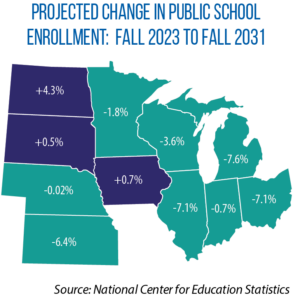
In Wisconsin, state projections show the population of school-age children (5 to 19 years old) to be 997,680 in 2040, an 11 percent drop from 2020. The Applied Population Lab at the University of Wisconsin projects public school enrollment in the state could be 13 to 15 percent lower in 10 years.
Along with these demographic realities, Duchow says consolidation has the potential of opening new opportunities, both academic and extracurricular, for students currently attending small schools.
“[Consolidated schools] can offer a lot more AP classes. They can have a football team. They’re actually going to have a marching band,” she says.
In Indiana, in studies produced for the state Chamber of Commerce, Ball State University researchers have explored the impacts of school district size. They found that districts with populations of between 2,000 and 2,999 students had the highest SAT scores, pass rates on standardized tests, and percentage of students graduating with honors. In contrast, smaller districts tended to have higher levels of learning loss and per unit costs.
Trends in Public School Enrollment | ||
State | # of students in fall 2023 | % change from fall 2015 |
Illinois | 1,846,264 | -9.6% |
Indiana | 1,032,723 | -1.3% |
Iowa | 508,112 | +0.02% |
Kansas | 483,505 | -2.5% |
Michigan | 1,426,491 | -7.1% |
Minnesota | 869,967 | +0.7% |
Nebraska | 329,162 | +4.2% |
North Dakota | 119,033 | +9.6% |
Ohio | 1,675,300 | -2.4% |
South Dakota | 141,467 | +5.4% |
Wisconsin | 814,202 | -6.2% |
Source: National Center for Education Statistics | ||
Details on Wisconsin bills
Wisconsin’s legislative package proposes several paths to consolidation.
• Under AB 644, districts would receive $1,500 per pupil for the first year following consolidation, $650 per pupil in the second year, and $150 per pupil in the subsequent three years. Under current law, districts receive $150 per pupil for the first five years post-consolidation, followed by reduced amounts in the sixth and seventh years.
• AB 648 would provide a second type of supplemental state aid, with a goal of shielding local property owners from tax increases if a newly consolidated district would have higher maximum allowed levy rates.
• AB 647 would provide grants for districts that remain independent but combine student instruction for certain grade levels — a shared-service model known as whole-grade sharing. The four-year grants would be $500 per pupil.

Rep. Cindi Duchow
The two other measures allocate funding for feasibility studies.
Under AB 645, grants of up to $25,000 would go to districts interested in either total consolidation or whole-grade sharing. AB 646 calls for a statewide analysis of Wisconsin’s school districts — for example, their staffing levels and salary scales, public transportation access, existing debts and assets, population distribution and pupil demographics. The study would result in recommendations for new district consolidations and boundaries.
The final bill in the package, AB 649, provides funding for the proposed state grants and aid. Estimated state costs are $5.95 million.
Impacts on rural areas
Although the various incentives being proposed in Wisconsin are voluntary, opponents argue multi-year declines in school funding have resulted in some districts having to consolidate.
According to the Department of Public Instruction, state aid for K-12 schools as a percentage of general-fund spending decreased from 43.1 percent to 31.2 percent between academic years 2004 and 2025. In addition, according to the Wisconsin Policy Forum, national per pupil spending increased by 21.1 percent between 2002 and 2023 (when adjusted for inflation). Wisconsin’s per pupil spending only increased by 2.4 percent during that same period.
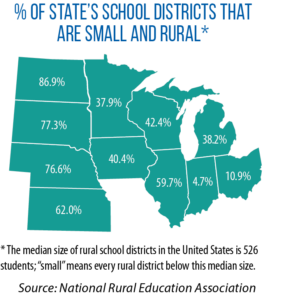 One concern is that consolidation could disproportionately affect small districts in rural regions, resulting in potential increases in student transportation times and decreases in home values areas where schools close.
Outside the Midwest, in a 2022 University of Kentucky study, researchers analyzed the effects of school consolidation on rural communities in Arkansas, where legislators passed a law (HB 1109 of 2003) requiring districts to reorganize if student populations dropped below 350. Using data from 2000 to 2015, the study found that state-mandated district reorganization not only led to fewer community schools, but also local losses in population, by 13 to 15 percent, and a $1,300 reduction in assessed property values.
Illinois law and proposal
Other states in the Midwest also have considered or successfully taken steps to encourage consolidation.
In Indiana, a failed amendment to a 2025 property tax bill (SB 1) called for counties with populations of under 50,000 people to only have one school district. In Illinois — which has the third highest number of regular school districts in the country — debates over consolidation have persisted for years.
 The Illinois State Board of Education already helps school districts pay for reorganization feasibility studies. Last year, lawmakers passed a bill (HB 2966) that seeks to more broadly promote this grant program and prioritize consolidation among contiguous districts with similar property tax rates and per pupil funding levels.
One of the co-sponsors of the bill, Rep. Rita Mayfield, previously attempted to pass HB 7.
That unsuccessful proposal from 2021 called for a state commission to evaluate how to reduce the number of school districts in the state by at least 25 percent, mostly through a greater use of “unit districts,” which administer both primary and secondary schools in the same area.

Rep. Rita Mayfield
The commission’s proposed school consolidations would have been subject to local voter approval.
According to the 2025 Illinois Report Card, 11.1 percent of the state’s school districts are high school-only and 42.8 percent are elementary-only.
Mayfield says in addition to potentially lowering tax levies because residents would fall under only one district, consolidation can reduce administrative costs. “We may not need multiple deputy administrators [or] three people in charge of curriculum,” she says.
Examples of School Consolidation Bills (2025-2026) | |||||
State | Bill Number | Description | Last Action | Last Action Date | |
Illinois | Amends the Regional Superintendent of Schools Article of the School Code. Requires the regional superintendent of schools to, beginning on August 7, 2028, exercise and perform all rights, powers, duties, and responsibilities that were vested in or required by law to be exercised and performed by former regional boards of school trustees and appoint a nonpartisan citizens committee consisting of five members to conduct the duties of the former regional board of school trustees. Provides that all books, records, maps, papers, documents, equipment, supplies, accounts, deposits, and other personal property belonging to or subject to the control or disposition of former regional board of school trustees shall be transferred and delivered to the regional office of education or education service center that services the same or substantially similar territory as the former regional board of school trustees. Effective immediately. | Assigned to Committee | March 4, 2026 | ||
Iowa | A bill for an act relating to incentives for whole grade sharing and school district reorganization or dissolution. (Formerly SSB 3146.) | Out of Committee | Feb. 19, 2026 | ||
Wisconsin | Relating to: grants for feasibility studies of school district consolidation or whole grade sharing. | Introduced or Prefiled | Nov. 20, 2025 | ||
Wisconsin | An Act Relating to: supplemental funding for whole grade sharing grants, supplemental state aid for consolidated school districts, grants for feasibility studies of school district consolidation or whole grade sharing, and making an appropriation. | Passed Original Chamber | Nov. 19, 2025 | ||
Wisconsin | Relating to: supplemental state aid for consolidated school districts. | Passed Original Chamber | Nov. 19, 2025 | ||
Wisconsin | Relating to: whole grade sharing grants for school boards. | Passed Original Chamber | Nov. 19, 2025 | ||
Wisconsin | An Act Relating to: requiring a school district consolidation study. | Passed Original Chamber | Nov. 19, 2025 | ||
Wisconsin | Relating to: grants for feasibility studies of school district consolidation or whole grade sharing. | Passed Original Chamber | Nov. 19, 2025 | ||
Wisconsin | Relating to: state aid for consolidated school districts. | Passed Original Chamber | Nov. 19, 2025 | ||
Wisconsin | An Act Relating to: requiring a school district consolidation study. | Introduced or Prefiled | Nov. 14, 2025 | ||
Wisconsin | Relating to: state aid for consolidated school districts. | Introduced or Prefiled | Nov. 11, 2025 | ||
Illinois | Amends the School Code. Requires the State Board of Education to analyze the use of grant fund requests for a consolidation analysis or consolidation expenses in relation to the School District Reorganization Feasibility Studies. Requires the State Board to create a list of overlapping or bordering school districts with the most similar operating tax rates and percentage of adequacy funding per pupil. Requires the State Board to communicate to the superintendents and school boards of those school districts on the list that the State Board's analysis makes the school district a good candidate for the grant funds. Requires the State Board to also provide to interested school districts a list of neutral parties to conduct an independent consolidation analysis with the grant funds. | Enacted | Aug. 15, 2025 | ||
Minnesota | K12 education finance and policy bill. | Enacted | June 14, 2025 | ||
Minnesota | Board of a consolidated school district renewal of an expiring referendum established pursuant to the consolidation authorization; requirements for school board renewal of an expiring referendum clarification. (see HF 5). | Introduced or Prefiled | April 1, 2025 | ||
Minnesota | Board of a consolidated school district authorized to renew an expiring referendum established pursuant to the consolidation, and requirements for school board renewal of an expiring referendum clarified. | Introduced or Prefiled | April 1, 2025 | ||
Iowa | A bill for an act modifying provisions related to the effective date of school district enlargements, reorganizations, changes in boundaries, and dissolutions, and including retroactive applicability provisions. (Formerly SF 16.) Effective date: 07/01/2025. Applicability date: 01/01/2025. | Enacted | March 12, 2025 | ||
Iowa | A bill for an act relating to incentives for whole grade sharing and school district reorganization or dissolution. (Formerly SSB 1076.) | Out of Committee | Feb. 26, 2025 | ||
Iowa | A bill for an act relating to school districts, including by modifying provisions related to school district dissolution proposals and election dates for school district mergers, consolidations, or dissolutions. | Assigned to Committee | Feb. 25, 2025 | ||
Illinois | Creates the Efficient School District Commission. Requires the Commission to make recommendations to the Governor, the General Assembly, and the electorate on the number of school districts in this State and where reorganization and realignment of school districts into unit districts would be beneficial. Provides that, on or before May 1, 2027, the Commission must vote on its recommendations and file a report with the Governor and the General Assembly. Effective immediately. | Introduced or Prefiled | Feb. 6, 2025 | ||
Illinois | Amends the Conversion and Formation of School Districts Article of the School Code. Within 3 years after the effective date of the amendatory Act, requires elementary school districts to form new school districts but only with other elementary school districts and high school districts to form new school districts but only with other high school districts, notwithstanding any referendum requirements or any other laws to the contrary. Provides that the State Board of Education shall facilitate the creation of the new school districts by providing recommendations on which districts must consolidate. Effective immediately. | Introduced or Prefiled | Jan. 31, 2025 | ||