In some states, allowing community colleges to award bachelor’s degrees seen as way to improve access, fill current and future workforce needs
For some of her constituents, Illinois Rep. Tracy Katz Muhl says, access to a four-year degree can seem out of reach because of the time it takes to get to and from the school itself.
“If you are a student, for instance, in the western part of my [legislative] district, it could take you 90 minutes in good traffic to commute to the nearest public university,” she says.
“And if you are an older student, if you are working, if you have child care, elder care or other responsibilities, the feasibility of being a commuter student like that just isn’t there.”
Her idea: Help them by allowing community colleges to offer certain types of bachelor’s degrees.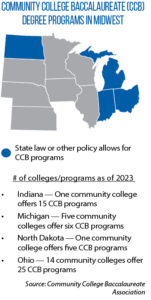
These schools are often geographically closer for many people, she notes. They also are accustomed to meeting the needs of non-traditional students and addressing the workforce needs of local communities.
Twenty-four U.S. states, including Indiana, Michigan, North Dakota and Ohio, already allow some or all public community colleges to award baccalaureate diplomas in targeted, high-demand fields, according to the Community College Baccalaureate Association.
Illinois and Iowa are among the states where bills were under consideration in 2026.
Jobs of today, tomorrow
Researchers at the Georgetown University Center on Education and the Workforce project that by the year 2031, 42 percent of all U.S. jobs will require a bachelor’s degree or higher (compared to 29 percent that will require only an associate’s degree or some college).
For jobs in certain high-demand fields, such as health care professionals and educators, openings will increasingly require applicants to have a bachelor’s degree.
Iowa Rep. Taylor Collins, author of this year’s HF 2649, told Iowa Public Radio earlier this year that he’s concerned a lack of baccalaureate-program access in parts of his state contribute not only to unmet workforce needs, but educational brain drain as well.
“Many of those folks that are in Council Bluffs, they’re going to the Omaha [metropolitan area] to get their education,” Collins said. “If you’re living in Des Moines County, you’re maybe going over to Monmouth College in Illinois or Western Illinois University.”
Under HF 2649, which passed in the House but stalled in the Senate, community college baccalaureate (CCB) programs would be introduced in Iowa as a pilot program.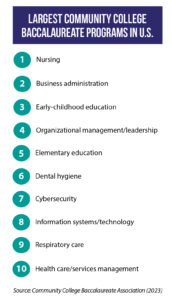
To not take away from or duplicate existing baccalaureate offerings, eligible community colleges would need to be located 50 miles from the main campus of a school already offering a similar degree.
Instruction could not be delivered entirely online, and each participating community college would be limited to a maximum of three baccalaureate programs. Enrollment numbers, workforce outcomes and employer engagement would need to be reported annually to Iowa legislators and education leaders.
In 2025, following legislator urging, the group Community Colleges for Iowa conducted a study of the potential use of CCB programs.
Its findings, as outlined in an interim and final report, identified regions of the state considered “educational deserts” (“areas with limited access to higher-education institutions, particularly public four-year options”) and singled out industry sectors with the greatest needs for applicants with bachelor’s degrees. Those sectors included manufacturing, information technology, health sciences and human services.
The same report articulated logistical hurdles that CCB legislation and implementation would need to address — for example, finding qualified faculty, making changes to school accreditation processes, and setting appropriate tuition levels. Addressing these issues, plus securing proper start-up funding, would be crucial for the CCB model to succeed in Iowa.
Other states have faced similar challenges in starting and scaling CCB programs, notes Ivy Love, a senior policy analyst with New America’s Center on Education & Labor. Her assessment is based on a survey she conducted in late 2024 with a group of administrators at rural, baccalaureate-granting community colleges from across the country — including Ohio. In terms of states that have been particularly successful in building and sustaining these programs, Love points to longtime-adopters Florida and Washington.
“[Those two states] have strong approval processes in place, they have opportunities for universities to give their perspective on a proposed program, and they have outcomes data that now we can look at and observe how they are working for students and graduates,” Love says.
Jobs in 2031: Forecasted % Requiring College Degrees | ||
State | Bachelor's | Associate's only |
Illinois | 25% | 9% |
Indiana | 20% | 11% |
Iowa | 23% | 15% |
Kansas | 22% | 11% |
Michigan | 22% | 11% |
Minnesota | 27% | 14% |
Nebraska | 26% | 12% |
North Dakota | 22% | 16% |
Ohio | 22% | 10% |
South Dakota | 24% | 14% |
Wisconsin | 23% | 14% |
United States | 26% | 13% |
Source: Georgetown University Center on Education and Workforce | ||
Filling a gap
Illinois lawmakers have debated the concept of CCBs for many years.
One proposal from nearly a decade ago (SB 888 of 2017) called for a pilot program to address workforce shortages in nursing. It did not pass.
Last year, CCB authorization was a priority initiative in Gov. JB Pritzker’s State of the State address. The resulting legislation, HB 3717, sought to grant such programs if a community college could, among other conditions, demonstrate that local workforce needs in a particular field were unmet and could explain why its new bachelor’s degree program would not be duplicative of existing offerings in the district. This bill also failed to reach a floor vote.
One concern raised by opponents is that allowing community colleges to offer baccalaureate programming could result in significant enrollment drops at public four-year institutions, particularly those serving minority and low-income students.

Rep. Tracy Katz Muhl
Rep. Katz Muhl, the primary sponsor of HB 3717, filed new language in another bill (SB 1988) in the final weeks of the spring 2025 session in an effort to address regional degree capacity and maintain institutional buy-in on proposed CCB programs. The language in that ultimately unsuccessful bill was later incorporated in this year’s HB 5319.
Under this latest proposal, Illinois community colleges would be divided into nine geographic regions. For the first three years, colleges in each region would be limited in the number of CCB programs they could offer and in the areas of study.
Additionally, community colleges could not have degree programs already administered by a nearby public university (20-mile radius for the City Colleges of Chicago and 40-mile radius for other institutions). However, they could appeal to the state if a rigorous feasibility study showed such offerings would address unmet workforce needs and improve equitable access to higher learning.
HB 5319 also provides a mechanism for universities to share bachelor-course professors with colleges. CCB tuition and course credit fees would be limited to 150 percent of regular community college prices.
Katz Muhl says one reason many universities shifted from opposing the CCB idea to having a neutral stance is that HB 5319’s language makes the goal clear: open opportunities to those who don’t have another viable option.
“This bill is, on the one hand, about capturing the students in the marketplace right now who tried to make that transition [from community college to university] and weren’t able to accomplish the degree,” she says.
“But it’s also for students who have been on the sideline for such a long time, who just knew right from the start that commuting to the nearest public or even private institution just wasn’t doable.”
A 2017 University of Florida study found that the introduction of CCB programs in that state had a negligible impact on public university enrollment, but a significantly negative impact on for profit, four-year school enrollment.
Community College Baccalaureate (CCB) Approval in Midwest States | |||
State | Year of Approval | Adoption Type | Bill # |
Indiana | 2004 | Institution | n/a |
Michigan | 2012 | State legislature | |
North Dakota | 2004 | Institution | n/a |
Ohio | 2018 | State legislature | |
Sources: "Updating the National Landscape: State Adoption of Community College Baccalaureate Degrees," University of Washington, 2019; and the Community College Baccalaureate Association | |||