Use of newly available federal funds is only one part of states’ plans to meet challenge of building sustainable rural health systems
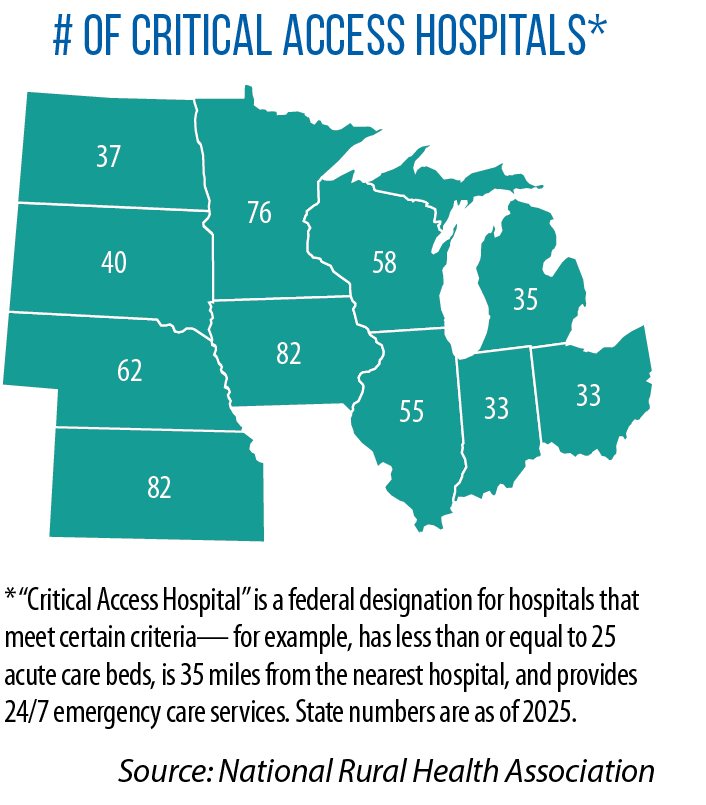
Across South Dakota, many communities and residents rely on one of the state’s 40 federally designated Critical Access Hospitals (CAH).
These hospitals are small, provide 24/7 emergency care services, and are located in a rural area with no other facility nearby. They are essential lifelines, Rep. Drew Peterson says, as he experienced firsthand with his own family.

Rep. Drew Peterson
Peterson credits a local CAH with helping save his wife and firstborn child’s lives during pregnancy and delivery at 27 weeks. Without access to nearby care and timely interventions, Peterson wonders whether he would have a family.
He wants to make sure future generations of rural South Dakotans don’t lose this access, and says one way to do so is through wise use of a new five-year funding stream for the state: the federal Rural Health Transformation Program (RHTP).
“We can serve our communities with these [RHTP] dollars,” Peterson says. “We can help keep these facilities open in our communities so that we can continue to allow people living in rural communities to have a high-quality of life, and keep them alive in certain cases, so that we can continue to have a vibrant state.”
Limits of federal program
The stability and long-term sustainability of rural hospitals — and rural healthcare, more broadly — became a central part of debate last year over HR 1, the 2025 law that makes significant changes in federal Medicaid policy and finance.
For rural areas, the law’s various provisions will result in a loss of $137 billion over 10 years, according to estimates by KFF, one of the nation’s leading organizations for health policy research.
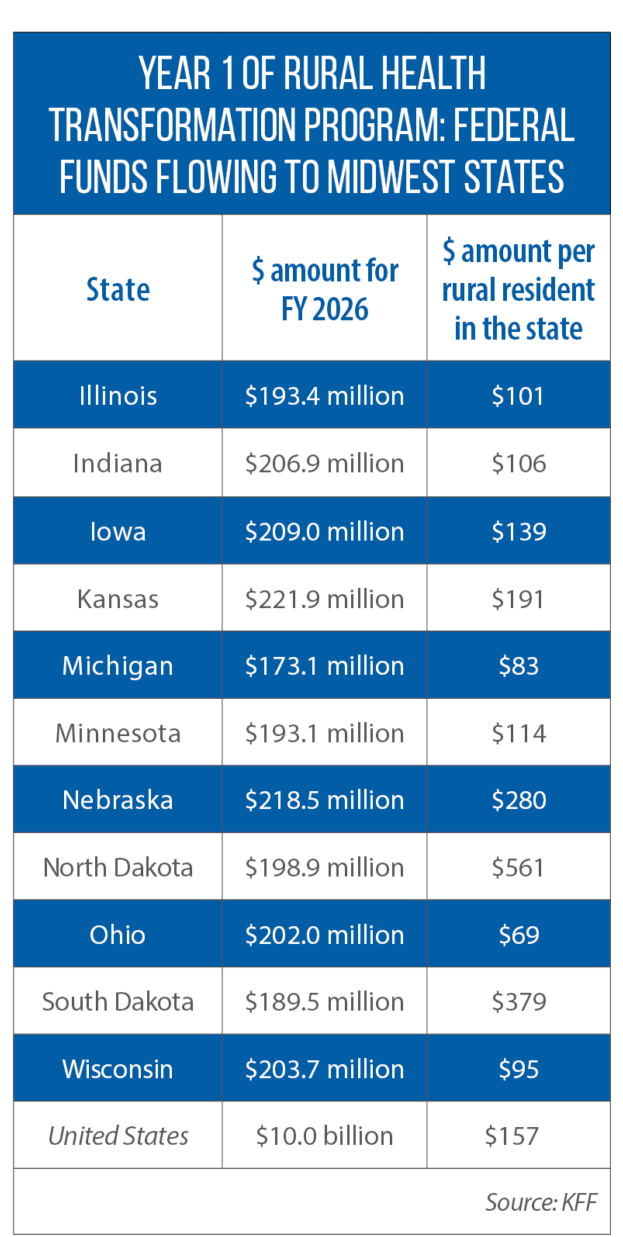
Concerns about that loss of federal funding led U.S. Congress to include the RHTP in the final version of HR 1. This program marks the largest targeted federal investment in rural healthcare in decades, with $50 billion in federal funds going to states over five years.
Earlier this year, Peterson encouraged passage of HB 1044, the South Dakota law creating a framework for the state to receive hundreds of millions of dollars in RHTP funding. To ensure oversight, the law requires the South Dakota Department of Health to submit quarterly expense reports to the Legislature. Kansas also requires reporting — annually for the program as a whole and quarterly for grant recipients. Ohio, meanwhile, requires stricter oversight, with legislative approval required before RHTP funds are disbursed.
In other states, oversight often rests largely with state agencies and/or voluntary updates from plan administrators.
The RHTP alone will not sustain rural hospitals. The program ends after five years and limits how much states can provide in directed payments to providers; that cap is 15 percent of total state program funds.
Additionally, the RHTP includes a clawback provision if states do not use funds in a manner consistent with their federally approved application. For many rural hospitals with limited staff, data collection and compliance requirements could make it challenging to demonstrate proper use of these funds and avoid such a clawback, particularly given the program’s accelerated rollout.
States, then, may need other strategies to stabilize at-risk hospitals, while investing their RHTP dollars in initiatives that transform rural healthcare over the longer term.
State stabilization efforts
Over the past 15 years, 11 CAHs in the Midwest have closed and another 17 have converted to facilities without inpatient care. Of the 852 rural hospitals in the 11-state Midwest region, 18 percent are vulnerable to closure and 40 percent are operating with negative margins, according to the National Rural Health Association.
In Minnesota, legislators have established a multifaceted plan to stave off hospital closures (SF 4612 of 2026), including $205 million for the state’s largest Level I trauma center, $500 million for a Hospital Stabilization Reserve Account, and $30 million for a statewide program supporting CAHs, rural emergency hospitals and other financially vulnerable facilities.
Illinois legislators, meanwhile, created an $85 million Distressed Hospital Loan Program (SB 3365), which will provide interest-free loans to prevent hospital closures and facilitate reopenings. The state’s budget also allocates $118 million in “add-on” payments to safety-net hospitals: facilities that serve a significantly high number of uninsured and low-income patients.
Shortly before congressional passage of HR 1, the Kansas Legislature approved SB 126, which increased the maximum hospital provider assessment from 3 percent to 6 percent of hospital net inpatient and outpatient operating revenue. This use of provider taxes is a common funding mechanism used by states to finance their share of Medicaid and fortify payments to hospitals and other providers.
The new Kansas law exempts CAHs and rural emergency hospitals from the provider assessment if they have revenues that fall below a specific threshold.
Notably, because Kansas is not a Medicaid-expansion state (it has not extended coverage to non-elderly adults with household incomes up to 138 percent of the federal poverty level), its provider assessment is not subject to future reductions. By contrast, under HR 1, expansion states must reduce hospital provider assessments to no more than 3.5 percent by 2032.
Transformation efforts
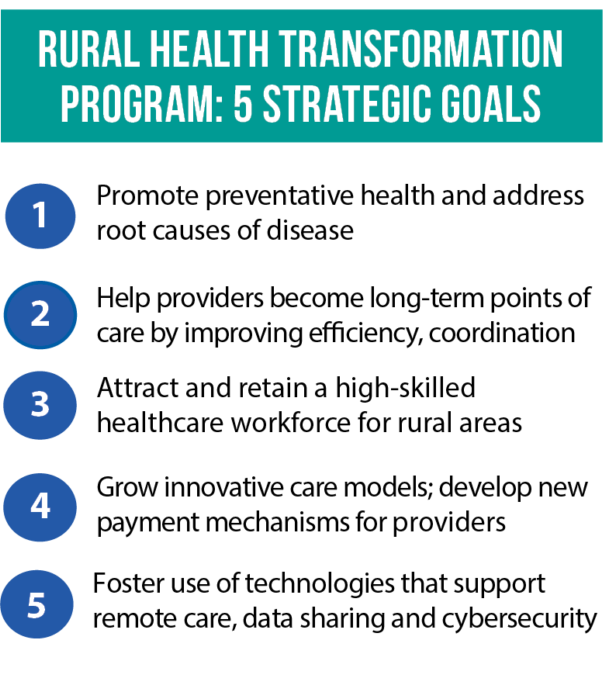
All Midwestern states have prioritized RHTP funds for two areas: technology innovation and workforce development. They are two of the five strategic goals established by the U.S. Centers for Medicare & Medicaid Services’ new Office of Rural Health Transformation.
In a June 2026 webinar hosted by The Council of State Governments’ Midwestern Legislative Conference Agriculture & Rural Affairs Committee, Keith Mueller, director of the Rural Policy Research Institute, pointed to one piece of that federal framework that may be particularly helpful to states looking to stabilize rural hospitals and providers over the long term: a shift to a value-based payment model.
“To fully transform the healthcare system in a way that benefits everyone, and to sustain that transformation, we’re going to have to realign payment incentives,” he said.
Specifically, Mueller said, states should use RHTP funds to help lay the groundwork for moving away from the current volume-based, fee-for-service payment system, which he described as poorly suited to low-density areas served by small rural hospitals.
He suggested that states look at incentivizing value-based systems where payments are based on outcomes rather than individual encounters.
“[It] potentially shifts healthcare spending away from encounters for the sick and the injured to spending that keeps people healthy,” he said.
In his analysis, Dr. Mueller determined that 23 states, including South Dakota, Kansas and Minnesota, included value-based payment initiatives in their first-year RHTP plans submitted to the Office of Rural Health Transformation.
A CSG Midwest review of state legislation related to H.R. 1 is available through this web resource: “Update: Year Marks Big Changes for States in Administering and Funding Medicaid.”